

The Hand Behind the Grimdark: John Blanche and the Making of Games Workshop

Some artists illustrate a world. A very few build one, then build the people who will go on building it after them. John Blanche was the second kind. Before we open the three paintings at the heart of our new anthology, we want to spend one post on the man himself: not the dates and the obituary, which we covered in June, but the legend, and the long, quiet work of making Games Workshop look, feel and think the way it does.
If you have ever held a Warhammer book and felt that the picture on the cover knew something the rules did not, you have met him.
The art director who handed out the brushes
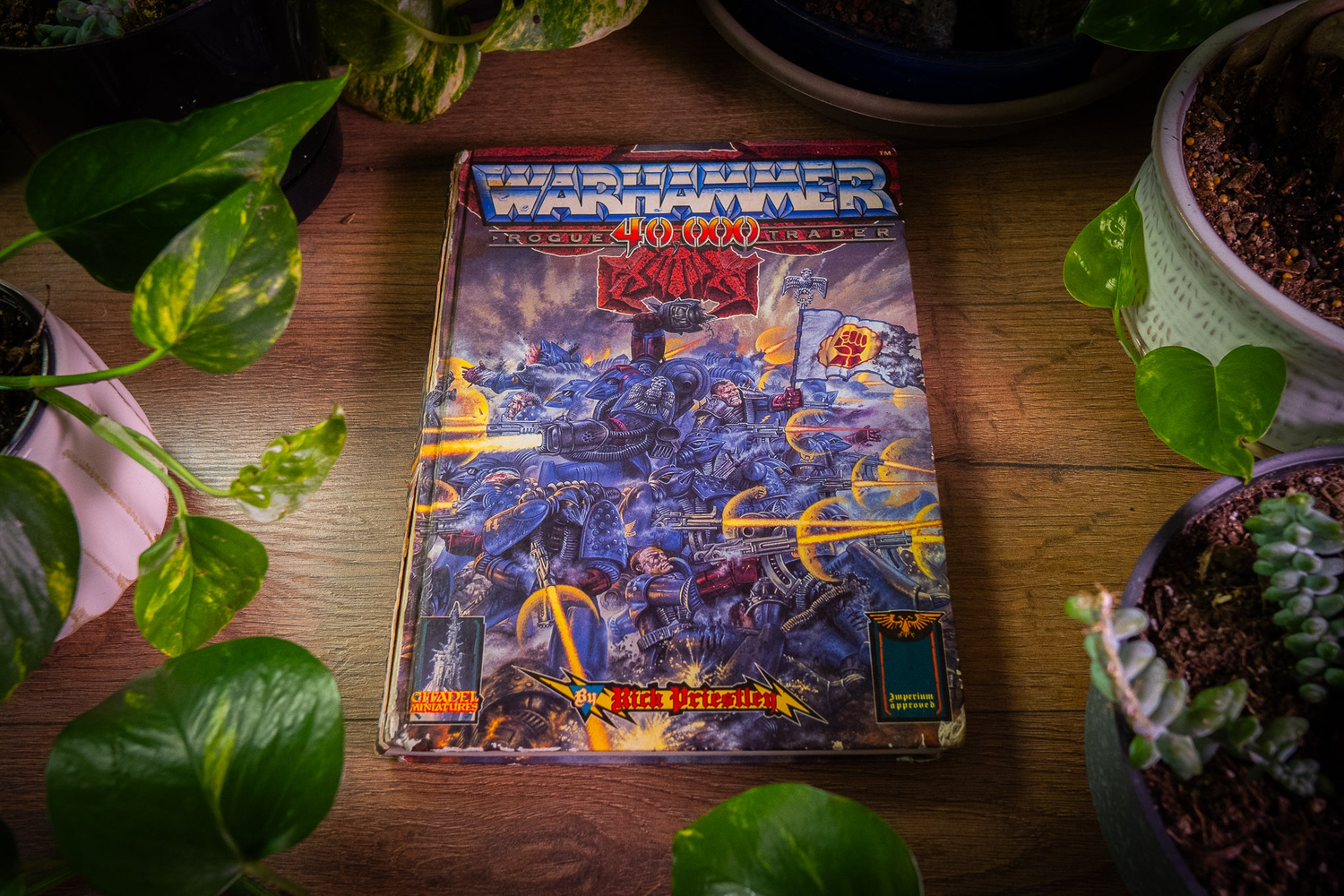
Blanche's name sits on some of the most famous paintings in the hobby, but his greatest work may be the work he gave away. On the original Rogue Trader in 1987 he was credited not as artist but as Art Manager, and he described the job plainly: he commissioned the art rather than painting it himself. From the Nottingham studio he ran the in-house art department, commissioned outside illustrators, designed for Citadel Miniatures and steered the art and painting pages of White Dwarf for years.

That is how one man's sensibility ended up on thousands of pages he never touched. The look we now call grimdark was not a house style imposed from above. It was a taste he taught, one brief, one conversation and one artist at a time.
Marc Gascoigne, who worked alongside him at Black Library, put it simply: "John set the style, tone and direction of Warhammer art across the decades."
Gallery trips and a borrowed Romantic
Blanche did not want his artists copying Games Workshop. He wanted them looking at Dürer, Bosch and Géricault. Gascoigne recalls him taking studio artists to London galleries to show them how the old masters could feed a new kind of fantasy, and pushing them toward fresh influences rather than repeating what had already worked.

You can see the lesson in his own covers. White Dwarf 84 borrowed its charge from Géricault's The Charging Chasseur. Amazonia Gothique, his cover for White Dwarf 79, was voted the best cover of its year and went on to become a poster and a metal miniature. He painted it as a deliberate answer to the exploitative fantasy art of the day.
He had a name for what came out of all that looking: "Games Workshop Gothic, which is inspired by, but is none of these things." Medieval, Romantic, Victorian and punk, all at once, and none of them exactly.
Knights in space, and a Dickensian future
Asked once why his worlds were so grimy, Blanche said he never saw fantasy as a place of shiny heroes: "it was all very Dickensian." Of the 3rd edition Space Marines he said, just as directly, that "they are medieval knights, but in space." Two sentences, and you have most of the visual grammar of the Imperium.

His aim, in his own words, was "trying to make our art visionary, make it lyrical, give it a narrative." That last part matters. A Blanche picture is never just a soldier standing still. Somebody is praying, somebody is dying, something enormous is watching, and the background is older than everyone in it.
A studio, not a signature
Look at the credits of the 1990s and his name is rarely alone. The Necromunda supplement Outlanders (1996) lists him beside Wayne England, David Gallagher, Mark Gibbons, Des Hanley and Richard Wright. Codex: Angels of Death pairs him again with England, Gibbons and Hanley. Adrian Smith, Karl Kopinski and many others did extraordinary work alongside him.

In 2013 he told an interviewer that the last two artists he had hired came from Madrid and Singapore, and that he felt "a sense of responsibility for all the staff we employ." His goal by then was to leave a legacy the studio could carry on with "once the old guard has gone." Colleagues remember a man who treated everyone as an equal and went looking for other people's ideas. He described himself the same way: "I belong to a community of people, rather than being some sort of icon."
When Games Workshop marked his death in June, it called him "a friend and mentor to many of us here at Games Workshop." Plenty of companies say kind things about former staff. Very few can point to a whole department built in one person's image.
In every corner of the hobby

The famous covers are only the surface. Blanche painted the cover of Epic 40,000 (1997) and of Battlefleet Gothic, the Black Templars box art for 3rd edition, and the Skeleton Horde box for Warhammer. He drew the Power Armour marks from I to VII that modellers still argue about, sketched Necromunda's Brats and Nomads, and gave Lord Gerontius Helmawr his face. He drew goblins for the Chaos Marauders card game and painted the Adeptus Titanicus cover of White Dwarf 108.
He compiled Inquis Exterminatus (Black Library, 2000), around 140 pages of 40K art from Rogue Trader onward, by many hands, arranged by faction. His notebooks for the 54mm Inquisitor game became The Inquisitor Sketchbook. He worked on Mordheim with Tuomas Pirinen. Outside Warhammer, his art filled Games Workshop's RuneQuest hardcovers, and Chaosium's president thanked him in June "for adding so much to the look of RuneQuest."

In his later years at the studio he moved toward sculpting and concept work, supplying drawings the miniature designers worked from. The fever dream became plastic.
What a legend is worth
The tributes this year have been remarkable for how far they reach. Writer Kieron Gillen said Blanche "set fire to a generation's imagination, and those fires show no sign of stopping burning." Simon Berman wrote that "it is impossible to discuss contemporary fantasy art without mentioning John Blanche." He is the centrepiece interview of the documentary The Grim and The Dark, the subject of a forthcoming tribute zine from Secret Passages, and the starting point for academic work on Warhammer.

The market has noticed too. One original, The Great Door in the Imperial Palace, a signed 1990 pencil drawing used in Codex Imperialis, was reported to have sold for £50,000. We treat that figure with care, since it comes from a single report with no auction record behind it. But it points in the same direction as everything else: the finished, original hand of John Blanche is becoming one of the most sought-after things in the hobby.

Before the studio
Everything above happened after Blanche walked into Games Workshop. But he was a painter long before he was an art director, and some of his most personal work was made before the Imperium had a name. Those pictures went into private hands and, for decades, more or less out of sight.
Three of them are in our care. Beginning October 26, The Missing Blanches takes each one in turn: what it shows, how it was made, where it came from, and what it might be worth. Consider this the prologue.

Subscribe to the Hammer of War blog to follow the series, and browse our John Blanche books and art while you wait.
Sources
- Trench Crusade: In Memoriam John Blanche, by Marc Gascoigne
- Exploring Warhammer: RIP John Blanche
- Sean Aaberg: Blanche Black Library interview
- LeftLion: John Blanche interview (2013)
- LeftLion: John Blanche obituary (2026)
- Warhammer Community: John Blanche
- Wikipedia: John Blanche
- Wikipedia: Outlanders (Necromunda)
- Lexicanum: John Blanche
- Tabletop Battles: Goonhammer pays tribute to John Blanche
- Chaosium: Vale and farewell, John Blanche
- Time Extension: John Blanche has died
- Bell of Lost Souls: Remembering John Blanche
- Wargamer: The Grim and The Dark review
- Rascal: Secret Passages tribute to John Blanche
- Spikey Bits: Blanche art sold for £50,000