
In Memoriam: John Blanche — The Man Who Made the Darkness Beautiful
June 3, 2026
The grimdark is a little darker today.
John Blanche, the visionary British illustrator and art director whose ink-stained imagination conjured the soul of Warhammer and Warhammer 40,000, passed away earlier this week. The news was shared by his wife Lin through long-time friend and collaborator Trish Carden, who wrote: "John was an inspirational artist, devoted to his family and a good friend to many. Always generous with his time and knowledge, he was very well loved by all who knew and worked with him. He leaves behind an enormous legacy that has enriched many people's lives."
He was 77 years old. The hobby world will not be the same without him.

From a Council Estate to the Golden Throne
John Blanche was born in 1948 into a working-class family in post-war England. He grew up on a council estate during the 1950s — a world he remembered as grey, flat, and starved of visual richness. So he made his own. He sketched warriors and battle scenes on the backs of spare rolls of wallpaper, because that was what he had. He collected toy soldiers. He lost himself in cinema. That hunger for the heroic and the fantastical never left him.
At art college, Blanche was warned directly: you have a romantic spirit, but it will never earn you a living. You will never get a job painting angels, dragons, goblins, and trolls. He quietly set about proving every word of that wrong.
After college he worked as an assistant to a taxidermist in a Georgian manor house, painting fantastic scenes in his spare time. His break came when he relocated to London and connected with artist and publisher Roger Dean, who gave him freelance illustration work. Through the late 1970s and early 1980s, Blanche's work appeared on book covers and inside pages across the fantasy and science fiction publishing world — including five illustrations for David Day's A Tolkien Bestiary.
In 1977, he began his decades-long relationship with Games Workshop, supplying cover art for the fourth issue of White Dwarf and the cover for the first British edition of Dungeons & Dragons. He went on to paint the box art for the first edition of Warhammer Fantasy Battle in 1983. By 1986, when Games Workshop relocated to Nottingham, Blanche had been made the company's Art Director — a role in which his influence became, by any measure, immeasurable.

The Architect of Grimdark
As Art Director, Blanche directed the in-house art department, shaped the visual direction of Citadel Miniatures, and oversaw the art and painting columns of White Dwarf for years. Working alongside artists like Ian Miller and Adrian Smith, he gave the Warhammer universes their unmistakable identity — dark, gothic, baroque, occasionally mad, and soaked in the punkish energy of a man who had absorbed Rembrandt, Bosch, Dürer, the Pre-Raphaelites, and the 1970s underground in equal measure.
His palette famously avoided blue, a quirk born from its tendency to fade over time. His preferred medium was pen and ink, expressionistic and frenzied where other artists worked with precision. Where fellow Asgard Miniatures alumnus Jes Goodwin brought meticulous architectural exactness to his sculpts and illustrations, Blanche brought chaos — controlled, beautiful, inspired chaos.
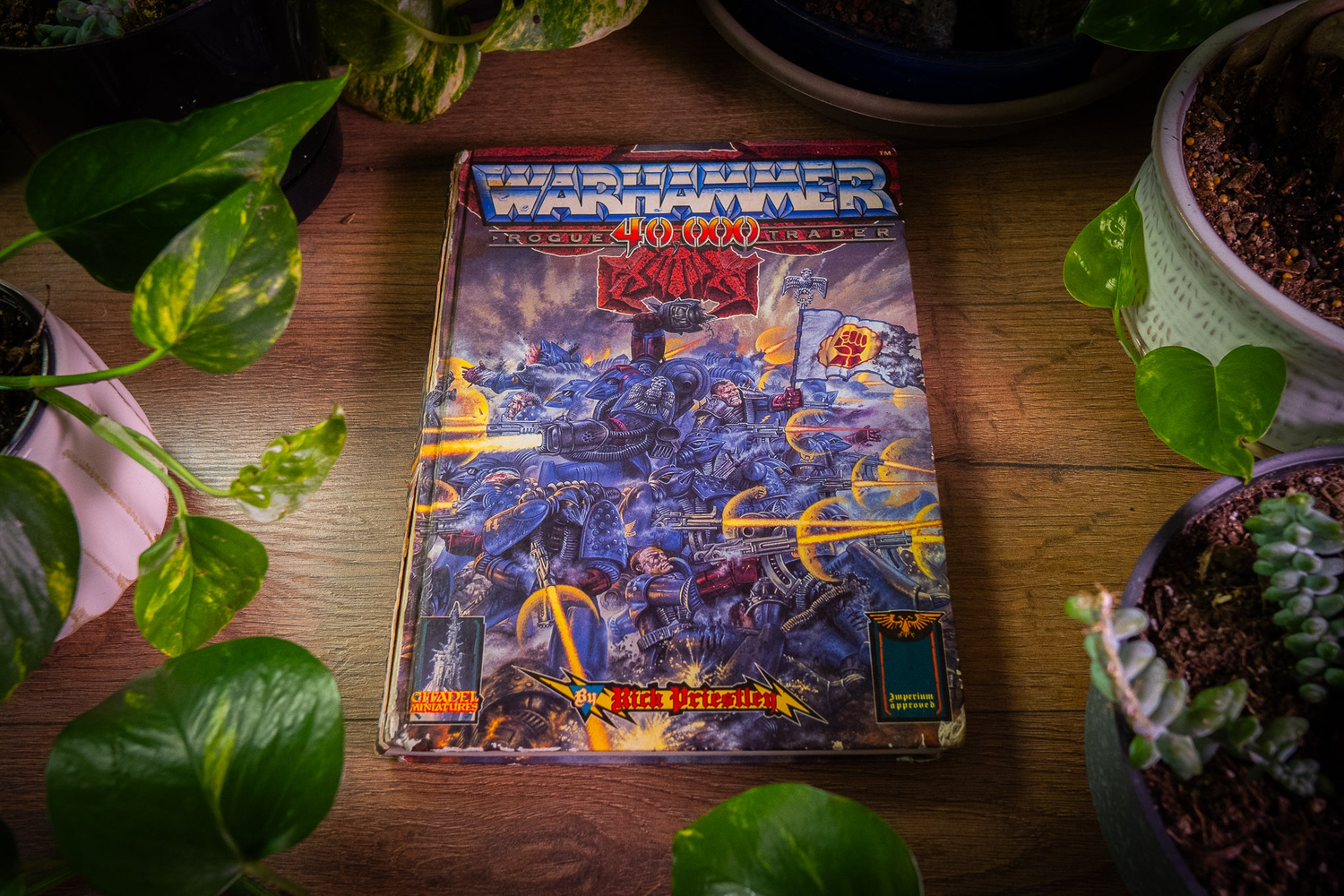
His most iconic single work remains the Emperor of Mankind entombed on the Golden Throne of Terra, a painting that still sits at the heart of Warhammer 40,000's visual and spiritual argument about what the Imperium actually looks like. When Games Workshop rushed to complete the Second Edition of Warhammer 40,000 in 1993, it was Blanche who answered the call — turning out an enormous volume of art at speed, including the celebrated Blood Angels versus Orks cover painting and the haunting illustrations of the Eternity Gate.
His style didn't just define a game. It defined a feeling. That feeling now has a name: grimdark. Though Blanche himself tended to call it baroque.
The reach of that style spread far beyond the gaming table. He painted the cover of Nottingham thrash metal band Sabbat's 1988 album History of a Time to Come. His work appeared in the Fighting Fantasy gamebook series and Steve Jackson's Sorcery! quartet. Standalone books collected his art — most famously Ratspike, created with Ian Miller. In 1987, he won the Master Painter award at Games Day for his own converted Chaos Minotaur miniature, complete with a hand-painted Mona Lisa banner.

Blanchitsu and the Birth of the Indie Scene
In the 2000s, Blanche became a central figure in something beyond the mainstream. He joined a loose collective of creatives building customized warbands for narrative, ultra-high-effort skirmish wargames — small, intimate games played in a single day where the modeling and painting was as important as the rules. Photos of these warbands were published in White Dwarf under the column name Blanchitsu, and the effect on the hobby underground was seismic.
From that foundation grew 28 Magazine, indie wargames like Turnip28, and the interconnected creative community that eventually enabled Trench Crusade to become a phenomenon. Blanche didn't just define the look of Games Workshop's biggest products — he quietly midwifed an entire independent scene that now flourishes around the edges of the hobby.
He officially retired from Games Workshop on 31 May 2023, having dedicated more than four decades to shaping one of the most recognizable fictional universes in modern gaming. But he didn't stop working. His final art project was Voodoo Forest, a series of linked pen and ink illustrations exploring an ethereal, surreal woodland released through Hollow Press. His last tabletop contribution was designing the characters for En Garde, a one-vs-one dueling game with rules by former colleague Tuomas Pirinen, featuring miniatures in the 54mm scale he loved.
Even in retirement, Blanche described himself as contentedly "living in the worlds he has helped to create."
Blanche: The Rise of Grimdark — The Book That Told His Story

In December 2023, Wombat Wargames published the official and authorized biography of John Blanche: Blanche: The Rise of Grimdark. It was a book that felt necessary precisely because his influence had for so long been felt everywhere while being formally documented almost nowhere.
The 218-page, full-color volume was as collaborative as everything Blanche touched. He approved every aspect of it — from the cover image, which held deep personal significance to him, to the overall layout and the balance of images to text. It was written with the clear intention of revealing John Blanche the person, not just the artist — and the contributor list alone is a testament to how many lives he shaped. Rick Priestley, Jes Goodwin, Tuomas Pirinen, Ian Miller, Trish Carden, and many others who built Warhammer alongside him all gave their voices to the project.
The book spans five decades of a career that defies easy summary. It traces the trajectory from that kid sketching on wallpaper in post-war England, through the London illustration years, into the long arc of the Games Workshop era, and out the other side into the indie skirmish and fine art work of his final years. It includes previously unpublished illustrations, personal photographs, and the kind of biographical depth that only a fully authorized project could achieve.
For those who already knew Blanche's work, it offered an entirely new dimension. For those discovering him, it was the essential introduction. And now, in the wake of his passing, it is something more: the permanent, personal record of a life that changed the way millions of people imagine the future.
The Legacy

When Games Workshop reaches back to honor its own history — as it did with the recently announced Warhammer 40,000 11th Edition box set, which draws directly on Blanche's Second Edition artwork — it is reaching back to Blanche. When a young painter posts a conversion warband built on rust, decay, and barely-contained menace, they are painting in a tradition Blanche built. When a novelist tries to put into words the feeling of the Imperium of Man — its horror and its grandeur, its beauty and its corruption — they are working in a space Blanche defined in ink and paint.
That is a legacy of genuine, lasting cultural weight.
"He'll be hugely missed," Trish Carden wrote. "The world of Warhammer was brought to life by his vision of the grimdark setting and I know his art meant a lot to so many of you."
Here at Hammer of War, where we have dedicated ourselves to preserving and celebrating the collectible history of this hobby, John Blanche's passing hits close to home. The games, books, and editions that carry his artwork are not just products — they are artifacts of a creative vision that is now complete. They are irreplaceable. And they matter more today than they did yesterday.
Rest easy, John. You built worlds.
If you are looking to find a copy of Blanche: The Rise of Grimdark — the official authorized biography published by Wombat Wargames — it remains available through Amazon worldwide. Given today's news, it is reasonable to expect demand to increase significantly. It is the definitive record of a singular life, and there is no better time to have it on your shelf.